

In Collaboration With

Overview
Blue Star Families’ annual Military Family Lifestyle Survey (aMFLS) has been providing a comprehensive understanding of the experiences and challenges encountered by military families since 2009. It offers crucial insight and data to help inform national leaders, local communities, and philanthropic actors—functions that are even more important as decision makers assess how to support military and Veteran families while the nation continues to recover from a global pandemic . The survey also presents the opportunity to increase dialogue between the military community and broader American society by highlighting areas for improvement and offering solutions to bridge the civil-military divide, strengthen communities, and bolster the health and sustainability of the All-Volunteer Force.
Blue Star Families conducted its 12th annual Military Family Lifestyle Survey from April to June 2021. Capturing experiences of over 8,000 respondents worldwide, and generating millions of data points, it remains the largest and most comprehensive survey of active-duty, National Guard, and Reserve service members, Veterans, and their families.
listen and learn
Did you miss part of the 2021 Military Family Lifestyle Survey results release event? Are you looking to catch up on the conversations? Press play on the videos below.
DAY 1 - Main Event
Hear leaders and families discuss the most pressing issues military- and Veteran-connected families are facing today.
DAY 2 - Data Deep Dive #1
Military Family Financial Security
DAY 2 - Data Deep Dive #2
Health and Mental Health
Featured videos
MFLS Opening Video
Financial Security Video
Military Family Building Video
What Does the DAta Say
2021 Survey Findings Summary
- Diversity: Four in 10 active-duty family respondents believe there is less racial discrimination in the military than there is in the general U.S. society.
- Resources/Military Quality of Life: Nearly a quarter (24%) of active-duty family respondents cite “military family quality of life” as a top concern. Families point to instability and inconsistency of daily life as the reason.
- Spotlight: National Guard and Reserve Families: National Guard and Reserve service members and their families report high levels of deployment activities in the last year, and many report they would recommend military service to young men and women.
- Family Building: The majority of military-connected family respondents (67%) have experienced at least one family building challenge in their lifetime.
- Spouse Health and Well-Being: Spouses are the backbone of military families.
- Military Children's Mental Health: Most active-duty family respondents to the 2021 MFLS report their children’s mental health is “good” or “excellent,” but a notable proportion (43%) rate at least one child’s mental health as “fair,” “poor,” or “very poor.”
Military Children's Education: Military children’s education remains a top-five issue of concern for active-duty family respondents (31%), as it has since 2018.
Spotlight: Global Citizens: The military community is rich in culture, ethnicity, and language. Military-connected respondents represent 95 countries of origin and 15% use a language other than English in their home.
- Employment Satisfaction: The majority of active-duty service member respondents (67%) are satisfied with their jobs and 70% feel the work they do is meaningful.
- Financial Stability and Housing: Already stressed by spouse un- and underemployment, student loans, and out-of-pocket relocation costs, military families making PCS (permanent change of station) moves face long military housing waitlists, unaffordable civilian housing markets, and expensive rental costs, which can further add to their financial burden.
- Spouse Employment and Child Care: Military spouse employment is again a top-five military life issue for nearly half (47%) of active-duty spouse respondents and a quarter of active-duty service member respondents (25%).
- Spotlight: Veterans: At the 20-year mark of the War on Terror, post-9/11 Veteran respondents, on average, show strong employment and financial positions. However, a greater proportion of those with a service-connected disability experience transition difficulties and a lack of preparedness for themselves and their families.
Reports
“I appreciate and believe this is a very important initiative for the military to pursue and continuously improve. Thank you for giving the people experiencing these challenges a voice.”
- 2021 MFLS Survey Respondent
MEDIA & PARTNERSHIP INQUIRIES
If you are a member of the media or a nonprofit organization that supports military- and Veteran-connected communities and you are interested in partnering with Blue Star Families to promote this research, contact [email protected].
BECOME A FUNDER
Funding for this needs assessment is provided through the generosity of our sponsors. If you are interested in funding further research, use the button below.
Quick Links
Executive Summary (PDF)
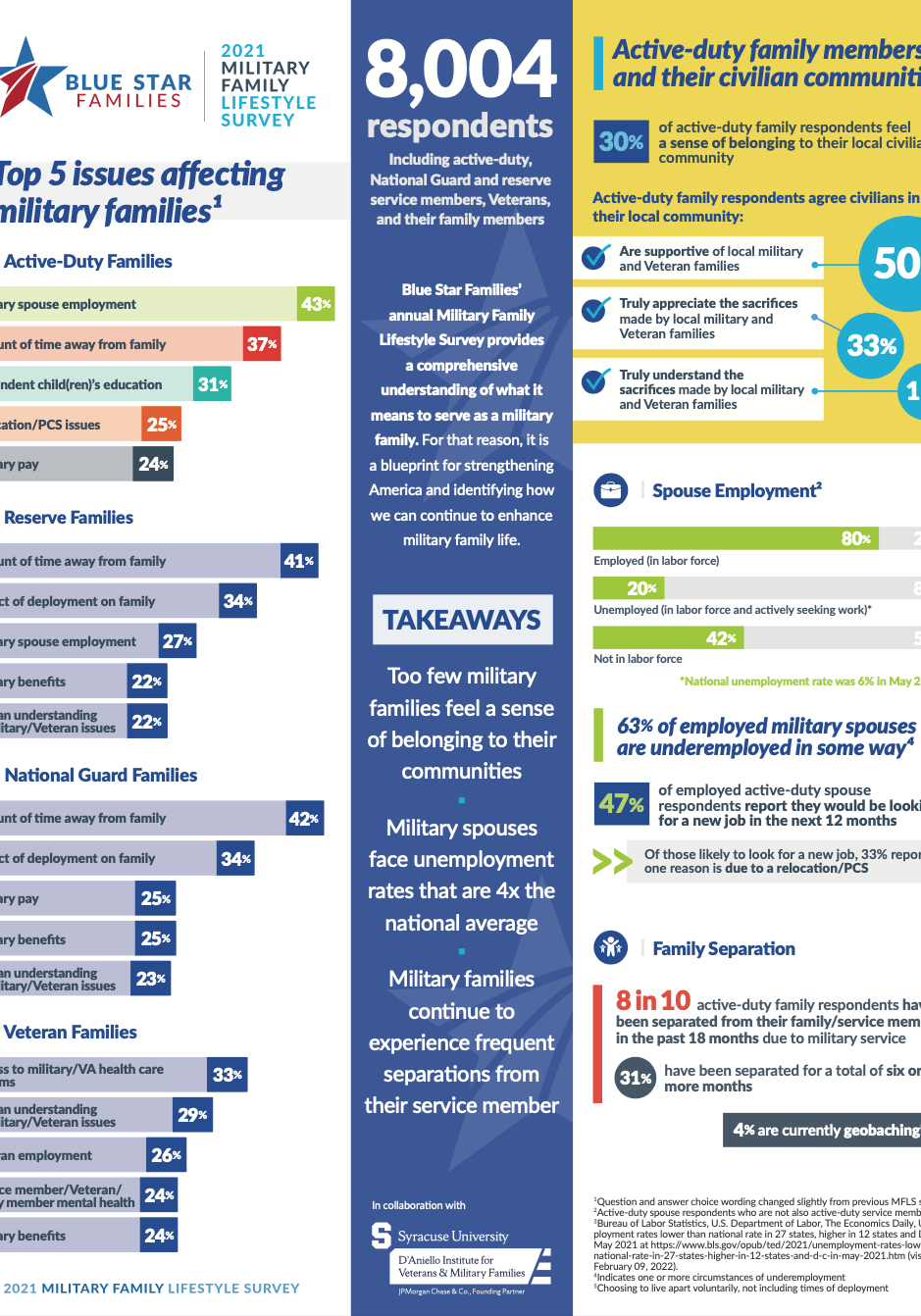
Comprehensive Infographic (PDF)
Comprehensive Report (PDF)
Recommendations (PDF)
Authors
From the Department of Applied Research at Blue Star Families in collaboration with the D'Aniello Institute of Veterans and Military Families, Syracuse University (IVMF).
Blue Star Families
Jessica D. Strong, Ph.D. Senior Director of Applied Research
Kim D. Hunt, Ph.D. Associate Director of Research and Training
Karly Howell, M.A. Senior Research Manager
Jennifer L. Akin, M.P.A. Senior Director of Policy and Social Impact Research
Charo Bates, M.B.A., M.A., M.S. USAA Applied Research & Social Impact DEPLOY Fellow
Carrie Carter, M.A. Applied Research Generalist Consultant
The D'Aniello Institute for Veterans and Military Families, Syracuse University
Rosalinda V. Maury, M.S. Director of Applied Research and Analytics
Rachel K. Linsner, M.S. Doctoral Research Fellow
Jeanette Yih Harvie, Ph.D. Research Associate
FUNDERS












In Collaboration With