United Military Families Campaign – Research 2024

Home » United Military Families Campaign » Research 2024
Research
At Blue Star Families, our work begins with data. Data allows us to quantify our members’ experiences and needs, enabling us to advocate for policy and systems changes that address their challenges. Following significant national events, we initiated efforts to understand the experiences of military families, particularly those from varying backgrounds. The findings from our inaugural report received national and local attention, leading to the establishment of an ongoing annual Research Series focused on these issues, summarized below.
Listen and Learn
Did you miss part of the 2024 results release event? Are you looking to catch up on the conversations? Press play on the videos below.
Survey Results Release 2024
Blue Star Families' United Military Families Campaign unveils the results of their annual Survey, highlighting key insights on fostering belonging and inclusion within the military community. Discover how they use the crucial findings and learn how they aim to build stronger connections and support systems for military families nationwide.
DEPLOY Fellowship Cohort 3 Graduation
Blue Star Families' United Military Families Campaign DEPLOY Fellows Cohort 3 share their personal experiences and insights gained during their fellowship. Learn how their work as DEPLOY Fellows has influenced their professional growth, shaped their future careers, and impacted the broader military community. Hear inspiring stories of dedication, leadership, and the pursuit of meaningful change.
Featured Videos
Keynote Address by Hon. Ron K. Keohane: Fostering Inclusivity in Military Families
Examining the Data: Exploring Community Impact and Diversity in Military Families
Strength in Diversity: Military Families and Community Integration
What Does the Data Say?
2024 Survey Findings Summary:
In 2022, our research revealed the core challenges military families, especially families of color, face when trying to feel included in their communities.
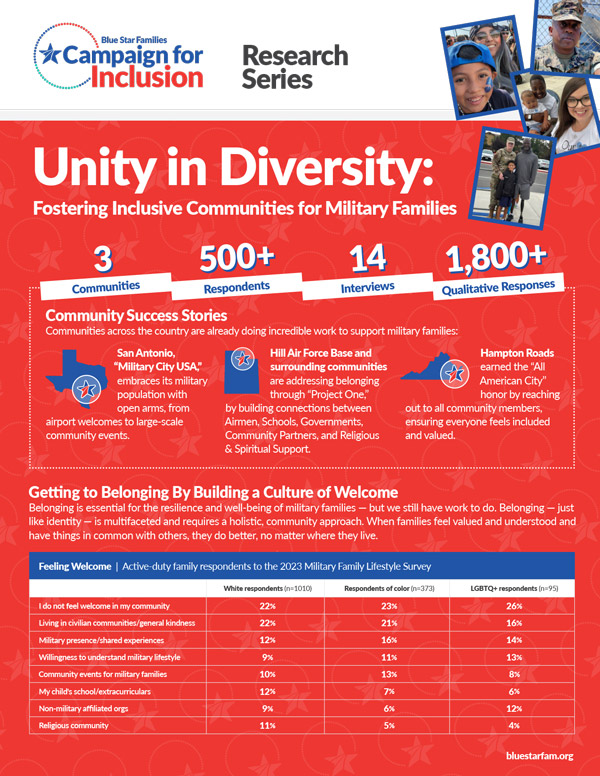
The study focused on three key military communities: Hill Air Force Base (Utah), San Antonio, Texas, and Hampton Roads, Virginia. Military families of color are disproportionately affected by issues like racism and lack of community support, directly impacting military readiness and retention.
- 1 in 3 active-duty families of color made the decision to turn down a military assignment (PCS or job) due to concerns about racism or lack of inclusion in the local community.
The challenges faced by military families of color are not just personal—they affect military readiness and long-term retention of service members.
Racism in local communities was the #3 reason why military families of color declined an assignment.
- Of those who turned down orders, 2 in 3 experienced negative career consequences. For 15%, it was career-ending.
Addressing these challenges doesn’t require massive budgets or resources. We have easy, low-cost solutions that can make an immediate difference, like Welcome Week and the Do Your Part initiative.
- These initiatives help create a welcoming environment for military families, encouraging community engagement and support with minimal cost.
Military families often identify primarily with their military affiliation, but many also have diverse racial, ethnic, and cultural identities. By being inclusive of military families, we are naturally fostering inclusivity across race, gender, religion, and other identities.
Military families of color will make up an increasingly larger portion of the U.S. military as most recruitable U.S. adults will be people of color within the next five years. This makes inclusivity not just a moral imperative, but a matter of national security to ensure long-term military readiness.
- 3 in 10 service members already identify as racial or ethnic minorities.
Blue Star Families can’t solve these challenges alone. It requires a collective, community-based effort. Everyone—from local communities, military installations, schools, and civilians—needs to be part of the solution by participating in Welcome Week and the Do Your Part initiative.
- Call to Action: Take simple steps to welcome military families. Host events, share resources, and be intentional about inclusion. It’s about doing your part, every day.
Our research has shown that while much attention has been given to service members of color, there was virtually no prior research into the experiences of military spouses and children of color. We conducted a comprehensive needs assessment that asked new questions and analyzed existing data, uncovering critical trends about military families of color that had been overlooked.
- The new report analyzes over 1800 open-ended responses with key resources and strategies directly from military families in 3 distinct communities.
When military families feel welcomed and included, it strengthens the entire community and improves retention rates within the military. Small actions, like those encouraged by Welcome Week and the Do Your Part, have a ripple effect, making communities stronger, more supportive, and better prepared to retain talented service members.
The solutions are right in front of us, and they are easy to implement. Let’s all Do Our Part by making simple, daily efforts to create a welcoming, inclusive environment for military families—no matter their background or identity. Participating in Welcome Week and other community-building efforts will ensure that military families feel supported and valued wherever they are.
Reports
The first report in this series, The Diverse Experiences of Military and Veteran Families (2021), aimed to uncover both the benefits of military service for various individuals and the unique challenges encountered during their military careers.
The second report, Building Bridges to Belonging for Military Families (2022), examined the experiences of military families in greater detail, specifically focusing on instances of discrimination. This report found that experiences of discrimination were more prevalent in civilian communities than in military settings. Notably, military families facing discrimination within their communities were significantly less likely to feel a sense of belonging or to recommend their community or military service to others.
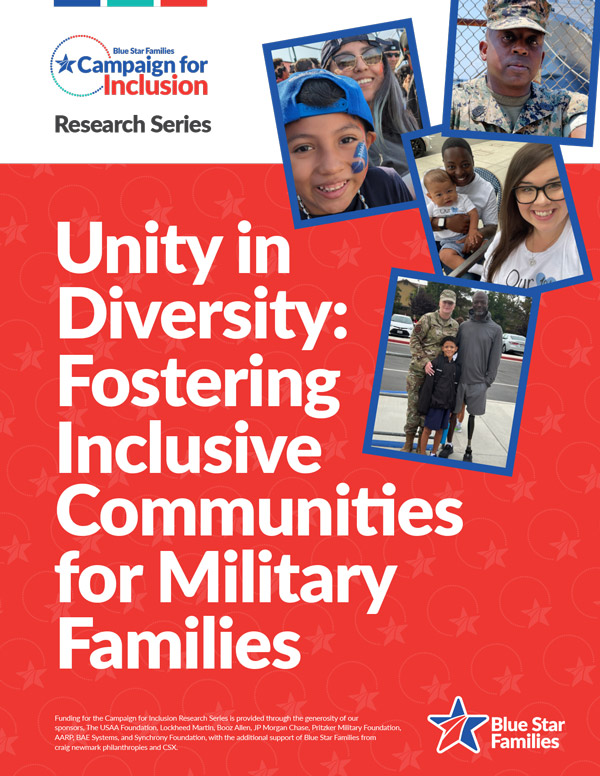
Addressing disparities affecting military families is a matter of national security, with implications both broad and local. Many experiences that influence military families — positively and negatively — are rooted in local communities, where most families reside. Our most recent research release, Unity in Diversity: Fostering Inclusive Communities for Military Families (2024), explores how community factors affect military families' sense of belonging and the resources and strategies they use to cultivate that sense within their communities. This report delves into three specific locations — Hill Air Force Base in Utah; San Antonio, Texas; and Hampton Roads, Virginia — to identify and recommend actions necessary for communities to promote belonging, trust, and safety for military families, while also highlighting the collaborations needed across public, private, local, and military sectors to support these conditions.
Media & Partnership Inquiries
If you are a member of the media or a nonprofit organization that supports military- and Veteran-connected communities and you are interested in partnering with Blue Star Families to promote this research, contact [email protected].
Funders
Funding for our research series is provided through the generosity of our sponsors, JP Morgan Chase and The USAA Foundation, with the additional support of Blue Star Families’ United Military Families Campaign from Craig Newmark philanthropies, CSX, Booz Allen, Pritzker Military Foundation, AARP, BAE Systems, and Synchrony Foundation.
Funding for this essential research is provided through the generosity of our sponsors. If you are interested in funding further research, use the button below.
Quick Links
Authors
From the Department of Applied Research at Blue Star Families, with the support of the team at the D’Aniello Institute for Veterans and Military Families at Syracuse University (IVMF). While IVMF collaborated on this research effort, the report itself was written by Blue Star Families.
Blue Star Families
- Jessica D. Strong, Ph.D. Senior Director of Applied Research
- Karly Howell, M.A. Associate Director of Research
- Brooke Blaalid, MSW Associate Director of Policy
- Kristen A. Higgason, MLIS Research Manager
In Collaboration With: