

In Collaboration With

Overview
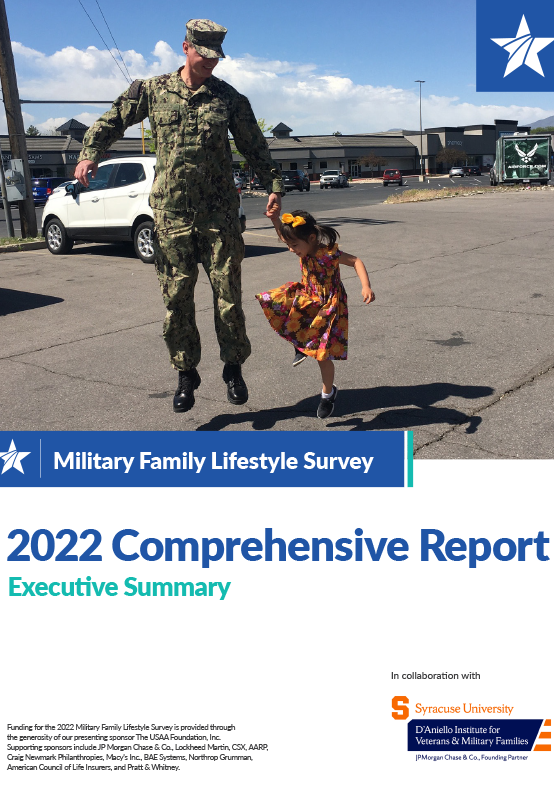
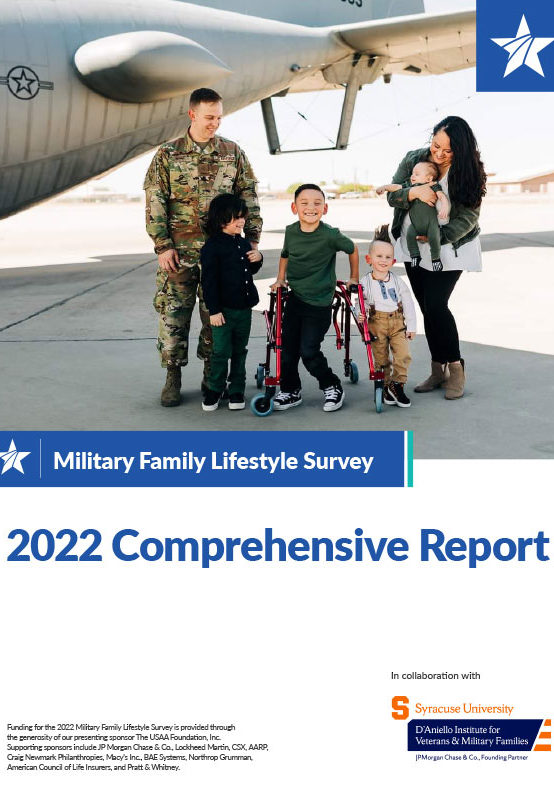
The 13th annual Military Family Lifestyle Survey, taken from May to July 2022, captured experiences of over 9,300 respondents worldwide and generated millions of data points. It remains the largest and most comprehensive survey of active-duty, National Guard, and Reserve service members, Veterans, and their families.
listen and learn
Did you miss part of the 2022 Military Family Lifestyle Survey results release event? Are you looking to catch up on the conversations? Press play on the videos below.
DAY 1 - Main Event
Hear leaders and families discuss the most pressing issues military- and Veteran-connected families are facing today in a fireside chat and panel discussion format.
DAY 2 - Data Deep Dive: Addressing the Recruitment Crisis
DAY 2 - Data Deep Dive: Supporting Families
Featured videos
MFLS Opening Video
CNN Anchor Brianna Keilar shares the origin of the Military Family Lifestyle survey and why it continues.
Importance of Programming Video
Discover the influence and reason for the programs we create at Blue Star Families.
Policy Impact Video
The results of the Military Family Lifestyle Survey impact many of the legislative calls for military policy changes we see today.
What Does the DAta Say
2022 Survey Findings Summary
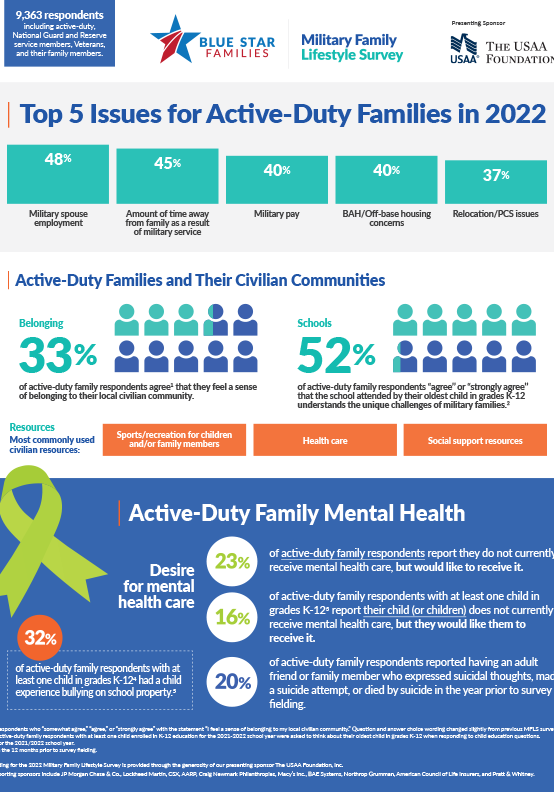
- Support Circles - Social support and mental health services are important to helping military families through common life stressors. Of active-duty family respondents, 1 in 5 (20%) reported having an adult friend or family member who expressed suicidal thoughts, made a suicide attempt, or died by suicide in the year prior to survey fielding, but just 25% of active-duty family respondents report feeling “very confident” in supporting a close friend or loved one experiencing a mental health crisis, such as suicidal thoughts or attempts.
- Family Relationships - While military life experiences such as PCS and family separation may be stressful, everyday life stressors of spouse employment, access to child care, and financial security have significant ties to relationship satisfaction. Active-duty spouse respondents who were employed, who were sometimes or always able to find child care, and those who were “living comfortably” or “doing OK” financially reported significantly higher relationship satisfaction than those who were not employed but want or need paid work, those who could not find child care, and those who were “just getting by” or “finding it difficult to get by.”
- Military Family Resource Access - A greater proportion of active-duty family respondents who had used civilian resources in the 12 months prior to survey fielding reported feeling a sense of belonging to their civilian community compared to their peers who had not used any civilian resources. Although a slightly greater proportion of active-duty family respondents reported using military resources, many also feel that their civilian community has sufficient or outstanding resources. However, at least a quarter of active-duty family respondents reported behavioral health, housing, community support, and medical care resources in their community were inadequate.
- Veteran Health Care and Social Support - Health care needs, perceived health care access and quality, and perceived network resources differ for working-age and aging Veterans. A greater proportion of working-age Veteran respondents reported they would like to receive mental health care but were not currently receiving it (14%) compared to aging Veterans (3%). Among aging Veteran respondents who reported they use the VA to meet all their health care needs, 68% “agree” or “strongly agree” that their doctor or provider is knowledgeable of health needs faced by the military and Veteran populations compared with 51% of their peers who said they do not use the VA for all care. Working-age Veteran respondents showed a similar pattern with 64% of those who use the VA to meet all care needs agreed their doctor or provider is knowledgeable of health needs faced by the military and Veteran populations versus 42% of those who do not use the VA for all their health care needs.
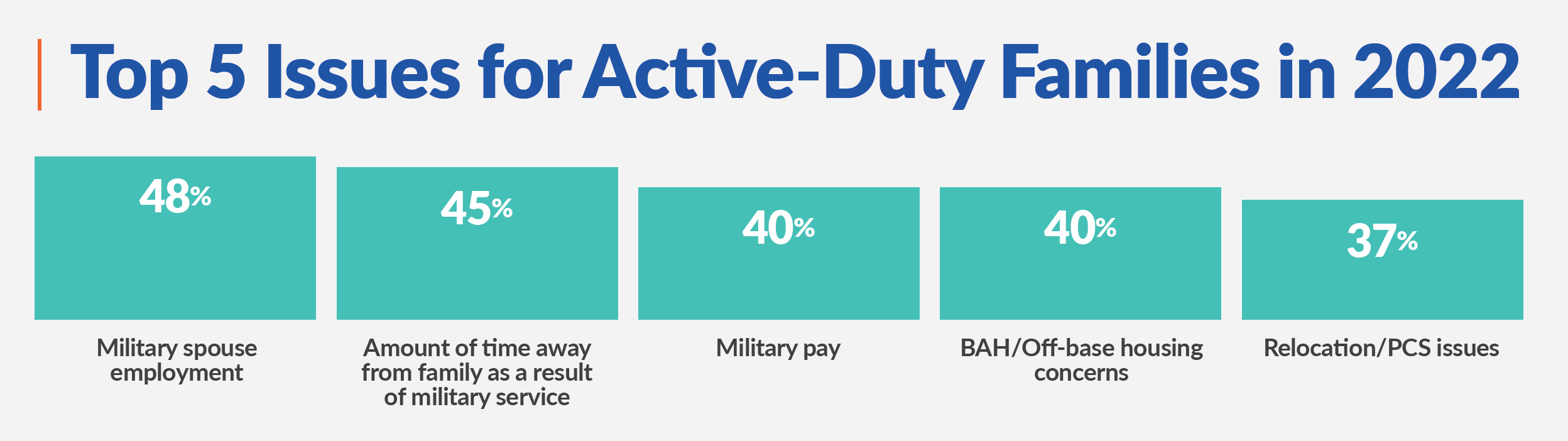
- Recommending Military Service - “Good benefits” and “economic stability” are top reasons for recommending military service, but “poor military leadership,” “challenges for families,” and “financial sacrifice” are cited by active-duty family respondents as top reasons they were unlikely to recommend military service. While the largest group of active-duty family respondents were likely to recommend military service (37%), about a quarter of active-duty family respondents (28%) were unlikely to recommend military service, and one-third were neutral (35%). Active-duty spouse respondents reported the lowest mean of likelihood of recommending military service, while Veterans reported the highest mean.
- Healthcare and Disordered Eating - While a valued benefit, TRICARE coverage has limitations that can result in out-of-pocket medical expenses for some military-connected families. More than 1 in 10 National Guard family (16%) and Reserve family (16%) respondents with financial stress reported medical costs as one of their top three financial stressors. Less than one-half (44%) of military-connected family respondents with eligible adult children have a child enrolled in TRICARE Young Adult; the most common reason respondents with eligible adult children did not enroll was that costs were “too expensive.”
- Children’s Mental Health - One in three active-duty family respondents (32%) with at least one child enrolled in grades K-12 for the 2021-2022 school year had a child (20 years or younger) experience bullying on school property in the 12 months prior to survey fielding. Sixteen percent of active-duty family respondents with at least one child in grades K-12 report their child(ren) does not currently receive mental health care but would like them to, most commonly citing difficulty finding an available provider (44%) as a reason they do not receive care. Additionally, 8% of active-duty family respondents with children in K-12 education reported they have a child who identifies as lesbian, gay, or bisexual, while 6% were “unsure”; 2% stated they had a child who identifies as transgender, and 3% were “unsure.”
Military Children’s Education - The majority (74%) of active-duty military families with at least one child enrolled in grades K-12 report they do not know about the Interstate Compact on Educational Opportunity for Military Children. However, those who have used the Interstate Compact to advocate for their child report positive outcomes. Knowledge of the Interstate Compact varied among subgroups. A greater proportion of active-duty family respondents whose oldest child enrolled in K-12 was in grades 9-12 knew about the Interstate Compact than those whose children were younger. Similarly, a larger proportion of those whose oldest child has an IEP and/or 504 Plan (and are enrolled in a public, private, or DoDEA school) reported knowing about the Interstate Compact than those whose child does not have an education plan.
Housing and Relocation - Concerns about “BAH/Off-base housing” is a top five military life issue for the first time. Active-duty family respondents continue to pay well over the expected cost-share to secure housing, while satisfaction with their housing situation declines for those who relocated more recently. Most active-duty family respondents prefer to live in civilian housing (55%) rather than military housing. However, the increasing cost and limited availability in the civilian housing market created challenges for many military families in obtaining acceptable housing comparable to military-provided housing within their BAH allotment.
- Financial Security - Military families’ financial well-being lags behind civilian peers. The military lifestyle intensifies financial stressors that may be experienced differently by active-duty family respondents of color. Although a majority of active-duty family respondents (72%) report their financial situation as “doing okay” or “living comfortably,” this is less than the proportion of the U.S. population as a whole who are in a similar financial situation (78%). The disparity is even greater for active-duty family respondents of color (67%).
- Food Insecurity - Food insecurity levels greater than the U.S. overall persist amongst active-duty family respondents; a quarter of enlisted families are reporting low/very low food security. Food insecurity is a symptom of financial insecurity, which may impact likelihood to recommend military service. Of active-duty family respondents, 16% reported experiencing low or very low food security levels in the 12 months preceding survey fielding, notably higher than the 10% of civilian families in the United States who experienced food insecurity in 2021.
- Spouse Employment - Self-employment and remote work address military spouse needs for employment flexibility. Part-time work, despite the potential for underemployment, may have financial benefits for military families. More than half of employed active-duty spouse respondents (61%) completed at least some of their work remotely in the month prior to survey completion. Many employed active-duty spouse respondents report they have a flexible work schedule (62%), and some have access to flexible work locations (50%).
- Child Care Spotlight - Child care continues to be both a necessity and barrier to military spouse employment. Affordable child care is elusive, particularly for spouses who are employed part time. A gap remains in the availability of child care options that meet the needs of working active-duty spouse respondents — 72% of respondents indicated that they would need some form of child care, but only 38% stated that they were able to find child care that works for their current situation.
- Veteran Financial Wellness Spotlight - Most Veteran respondents said their family was “doing okay” financially or “living comfortably,” but housing costs, major home repairs, excessive credit card debt were primary financial stressors. For aging Veteran respondents, however, medical costs were also cited as a top source of financial stress. While 70% of all Veteran respondents reported that their family is "doing okay" or "living comfortably" when it comes to finances, a smaller proportion of aging Veteran respondents (50%) reported financial stress compared to their working-age counterparts (82%). However, for Veteran respondents who have financial stress, one-quarter of aging Veteran respondents and 19% of working-age respondents identified medical costs as a top contributor to financial stress.
Reports
“In order to work, I need full-time child care. But child care was expensive and it didn’t make sense. Next year both my kids will attend public school.”
- Active-Duty Navy Spouse
MEDIA & PARTNERSHIP INQUIRIES
If you are a member of the media or a nonprofit organization that supports military- and Veteran-connected communities and you are interested in partnering with Blue Star Families to promote this research, contact [email protected].
FUNDERS
Funding for the 2022 Military Family Lifestyle Survey is provided through the generosity of our presenting sponsor The USAA Foundation, Inc. and from supporting sponsors Lockheed Martin, Craig Newmark Philanthropies, Macy’s Inc., AARP, BAE Systems, Northrop Grumman, American Council of Life Insurers, and Pratt & Whitney.
Funding for this essential research is provided through the generosity of our sponsors. If you are interested in funding further research, use the button below.
Quick Links
Executive Summary (PDF)
Comprehensive Infographic (PDF)
Comprehensive Report (PDF)
Recommendations (PDF)
Respondents & Methodology (PDF)
Spanish-Language Respondents (PDF)
Authors
From the Department of Applied Research at Blue Star Families in collaboration with The D'Aniello Institute for Veterans & Military Families, Syracuse University (IVMF).
Blue Star Families
- Jessica D. Strong, Ph.D. Senior Director of Applied Research
- Roger Brooks, M.A. Associate Director of Research
- Brooke Blaalid, MSW Associate Director of Policy
- Karly M. Howell, M.A. Senior Research Manager
- Ana C. Jackson, MSW Evaluation Manager
- Ashley B. Scott Policy and Innovation Coordinator
- Esmeralda Gloria Policy Fellow
- Kim D. Hunt, Ph.D. Senior Applied Research Analyst Consultant
- Kristen A. Higgason Applied Research Assistant Consultant
- Jessica Moser Spanish Translation Consultant
The D'Aniello Institute for Veterans and Military Families, Syracuse University
- Rosalinda Vasquez Maury, M.S. Director of Applied Research and Analytics
- Rachel K. Linsner, M.S. Research Associate
- Jeanette Yih Harvie, Ph.D. Research Associate
- Mariah Brennan Nanni, M.P.A. Doctoral Research Fellow