United Military Families Campaign – Research 2022
Home » United Military Families Campaign » Research 2022
Research
Blue Star Families' research informs all of our work. Therefore, research and advocacy are key pillars of the United Military Families Campaign (UMFC). Our groundbreaking study, 'The Diverse Experiences of Military and Veteran Families,' provides unparalleled insight into the varied experiences of military families.
This study includes focus groups, extensive review of existing literature, new analysis of existing military and Veteran data. More importantly, this study offers solutions.
The Blue Star Families team interviewed more than 100 government, nonprofit, community stakeholders to identify and prioritize action and start new conversations about how to create sustainable change.
Listen and Learn
Did you miss part of the 2021 Understanding the Diverse Experiences of Military and Veteran Families survey results release event?
Day 1 - Storytelling Event
Hear the stories and real-world implications of the results from our Understanding the Diverse Experiences of Military and Veteran Families survey. Meet the leaders who have helped shape this research and learn about the steps taken to better the world around us.
Day 2 - Data Deep Dive #1
Survey findings around the inextricable link between military families, communities, and readiness + the service member and Veteran experience.
Day 2 - Data Deep Dive #2
Survey findings around military families experience with finances, their children, and resources and services.
Featured Videos
REI Opening Video
Community Engagement Video
DEPLOY Fellowship Video
REI Committee Video
Mentorship & Allyship Video
What Does the Data Say?
2021 Survey Findings Summary:
Some active-duty family respondents make military life decisions based on their family's racial/ethnic composition that directly impact the retention of service members of color.
Issues Explored:
- What decisions military families make due to fears of racism or discrimination
- Impacts of these decisions on service member's careers
- U.S. regions where military families feel comfortable (or not)
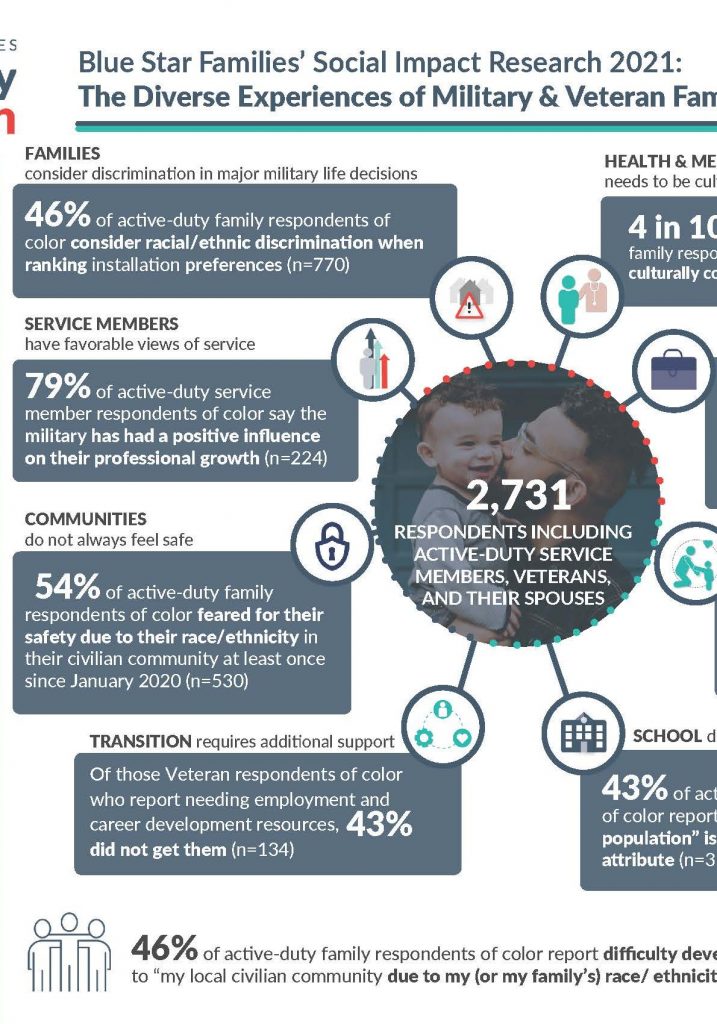
46%
of active-duty family respondents of color considered racial/ethnic discrimination when submitting base/installation preferences.
Active-duty service member respondents of color report challenges to their career progression and perceive racially/ethnically-based discrimination in evaluation and promotion.
Issues Explored:
- How service members perceive their ability to advance in their careers
- What the workplace environment looks like for service members
- Ways peers can help improve experiences for their colleagues
39%
of active-duty service member respondents of color report their race/ethnicity hurt their ability to get ahead at work.
Black and Hispanic/Latino/a/x active-duty families transitioning out of service face greater challenges than their white, non-Hispanic peers and report accessing available benefits, resources, and services at greater rates.
Issues Explored:
- How transition challenges differ by race/ethnicity
- Which benefits, resources, and services transitioning service members access
- The impacts of these experiences on finances
43%
Of those Veteran respondents of color who reported needing employment and career development resources since January 2020, did not get them.
Active-duty family respondents of color report experiencing harassment and police profiling across all U.S. regions, both on and off installation, and reports are most prevalent among Black respondents.
Issues Explored:
- The frequency of experiencing fear, harassment, and police profiling since January 2020
- U.S. regions where experiences of fear, harassment, and profiling have occurred since January 2020
- Perceptions of safety in military and civilian communities
54%
of active-duty family respondents report fearing for their personal safety at least once in their civilian community due to their race/ethnicity since January 2020.
A greater proportion of Veteran family respondents of color report needing resources than their active-duty counterparts; variation exists by race/ethnicity, and uncertainty about eligibility and access are top barriers.
Issues Explored:
- Which resources have the highest levels of unmet need
- Whether resource and service needs differ by race/ethnicity
- Barriers to accessing needed resources
60%
of Veteran family respondents of color who require caregiving resources report their need is not being met.
Active-duty family respondents of color perceive their financial circumstances to be better than those of their civilian family and friends of similar racial/ethnic backgrounds, but many report low confidence in wealth-building and investment strategies, which may have implications for their financial wellness in the future.
Issues Explored:
- Whether or not military service has financial benefits
- How has the COVID-19 pandemic impacted family finances
- Level of food insecurity and ability to access food and nutrition services by race/ethnicity
51%
of active-duty respondents of color report their family's financial stability is better than their friends and family of the same racial/ethnic background who are not serving in the military.
Military spouses of color report a greater need for two household incomes than their white, non-Hispanic peers, and they experience substantially higher unemployment rates and lower earnings than their civilian counterparts.
Issues Explored:
- How much lower earnings are compared to civilians, considering military affiliation, gender, and race/ethnicity
- Whether or not career disruptions disproportionately impact military spouses of color
- Barriers to accessing career-related support systems and resources
49%
of active-duty spouse respondents of color report their ability to advance within their career is worse than their non-white family and friends.
Despite mostly positive employment outcomes, Veterans of color face unique challenges when compared to white, non-Hispanic Veteran counterparts.
Issues Explored:
- What employment benefits Veterans of color experience compared to civilians
- Whether or not differences in Veteran employment outcomes exist by race/ethnicity and gender
- Perceptions racial/ethnic discrimination in the civilian workplace
41%
of Veteran respondents of color indicate they are better able to find a job, compared to their non-white family/friends who are not connected to the military.
Active-duty and Veteran family respondents of color perceive better health care quality and overall health than their civilian counterparts. However, those using a civilian health care provider rank their quality of care as higher than those using a military treatment facility or VA provider.
Issues Explored:
- Whether civilian, military, or Veteran health care providers are rated more favorably
- Ability to find culturally competent providers
- Mental health and caregiving outcomes
4 in 10
active-duty and Veteran family respondents of color cannot find culturally competent health care.
Active-duty and Veteran family respondents of color perceive better health care quality and overall health than their civilian counterparts. However, those using a civilian health care provider rank their quality of care as higher than those using a military treatment facility or VA provider.
Issues Explored:
- Whether civilian, military, or Veteran health care providers are rated more favorably
- Ability to find culturally competent providers
- Mental health and caregiving outcomes
4 in 10
active-duty and Veteran family respondents of color cannot find culturally competent health care.
Respondents of color report their race/ethnicity has the strongest influence on their overall identity, but their stories underscore uncertainty regarding which aspects of their identity are influencing their negative experiences.
Issues Explored:
- Which groups identify most with their race/ethnicity
- How identities impact experiences of service
- The effects of having more than one historically-disadvantaged identity
78%
of active-duty and 74% of Veteran family respondents of color report their race/ethnicity influences their overall identity.
Most respondents of color view the military's "colorblind" mentality as inaccurate and potentially corrosive and recognize racial equity work is both necessary and divisive.
Issues Explored:
- What the benefits and drawbacks of the military's "colorblind" mentality are for military readiness and service member experiences
- How respondents perceive racial equity research and initiatives
- Whether or not respondents perceived the required 2021 extremism training to be effective, what they report worked, and their suggestions for improvement
57%
of active-duty family respondents of color report they have heard their military-connected peers make racist comments or jokes about other peers.
Recommendations
Build Stronger and More Inclusive Relationships Within Military and Veteran Communities
- Be an Ally: Speak up against racism and racist comments.
- Actively pursue inclusive mentorship opportunities and integrate them into existing job requirements and programs to support all military- and Veteran-connected groups, including spouses and military children.
- Provide military and Veteran service members and families opportunities to engage in difficult but productive conversations about race, ethnicity, and more.
46%
of active-duty family respondents of color report they have been the subject of slurs or jokes at least once in their military community since January 2020.
Empower Communities and Installations to Support Military and Veteran Families of Color
- Allocate additional resources to strengthen civil-military relationships at the local level and bolster support systems on installations.
- Collaborate at the local level and proactively include military- and Veteran-connected families of color in local community conversations about diversity, equity, and inclusion (DEI).
- Infuse local civilian organizations with diverse talent and knowledge about military and Veteran communities by hiring more military spouses, Veterans, and spouses of Veterans of color.
Only 30%
of Black active-duty family respondents of color trust their local civilian law enforcement, and half trust military law enforcement.
Strengthen and Diversify the All-Volunteer Force
- Update diversity, equity, and inclusion (DEI) plans to address challenges military dependents of color face and identify best practices for working with local civilian communities to solve them.
- Apply best practices from other industries and sectors to support service members of color throughout their time in service.
- Assess existing military entry paths and remove barriers to entry for prospective service members of color.
- Continue to diversify ROTC scholarship recipients through broader recruitment, and assess program completion and commissioning rates among those enrolled in the program.
Improve Data Collection and Understanding
- Improve existing data collection to identify and address disparities for service members, Veterans, and family members of color in a more reliable and timely fashion.
- Explore how to use existing data to improve experiences for military and Veteran families of color.
- Deepen understanding of issues identified in this report and others.
30%
of active-duty family respondents of color turned down orders, knowing that it may negatively impact the service member's career.
Best Practices
White Oak Collaborative Subcommittee on Racial Equity and Inclusion: Recommended Practices for Military and Veteran Serving Organizations
- Be intentional
- Gather data
- Implement equitable and inclusive policies and practices
- Train managers and staff
- Engage more and better: Diversity brings diversity
- Review progress and develop new goals
Visit our Collaboration page for in-depth details.
How the Private Sector & Philanthropic Foundations Can Support Military and Veteran Families of Color
- Highlight the importance of serving military and Veteran families of color among existing grantees.
- Invest in organizations that support and have a strong staff and board representation from military and/or Veteran families of color.
- Consider supplier diversity.
- Break down walls between existing initiatives within your company. Initiatives that support military or Veteran families, and initiatives that support DEI work should not be mutually exclusive or operate in silos.
Reports
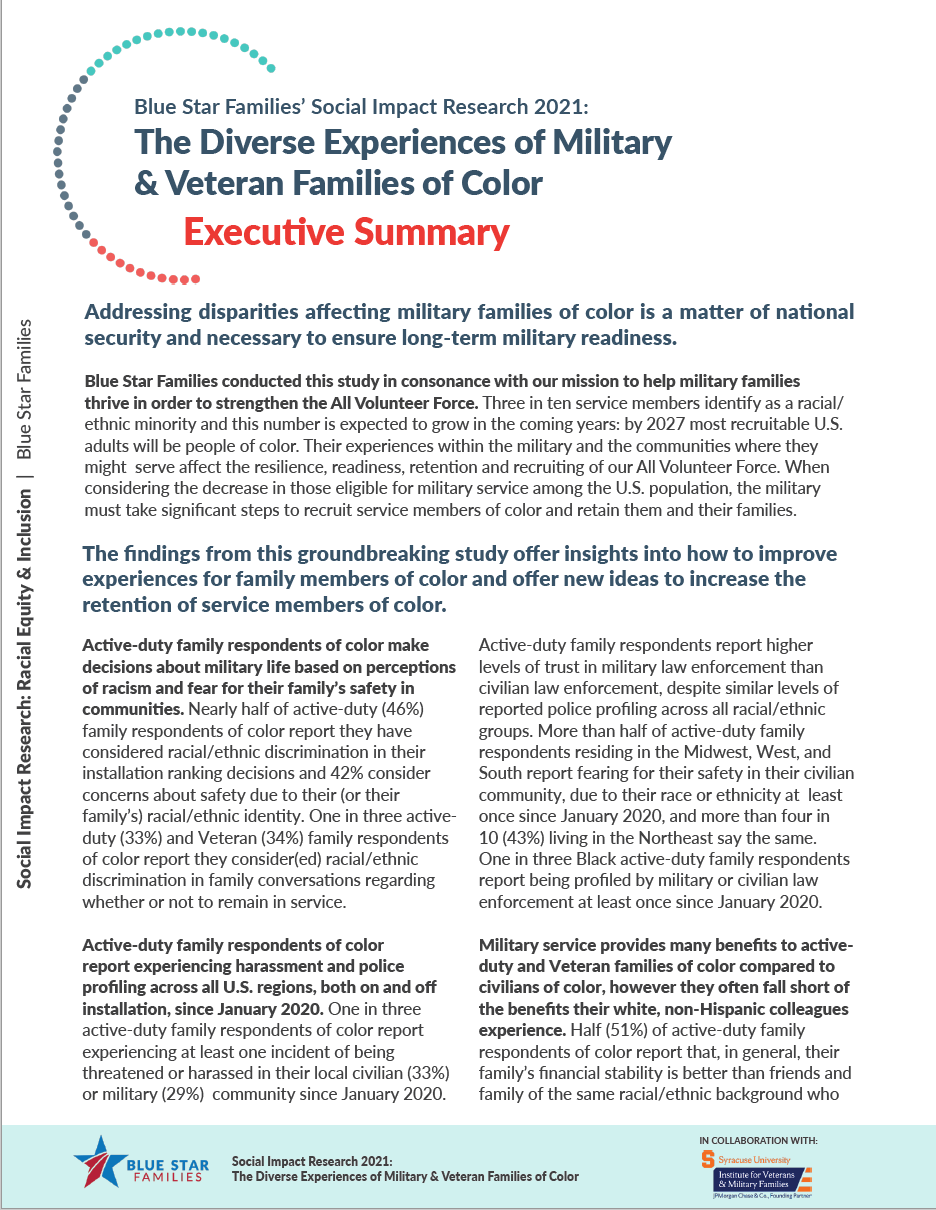
2021 Comprehensive Infographic
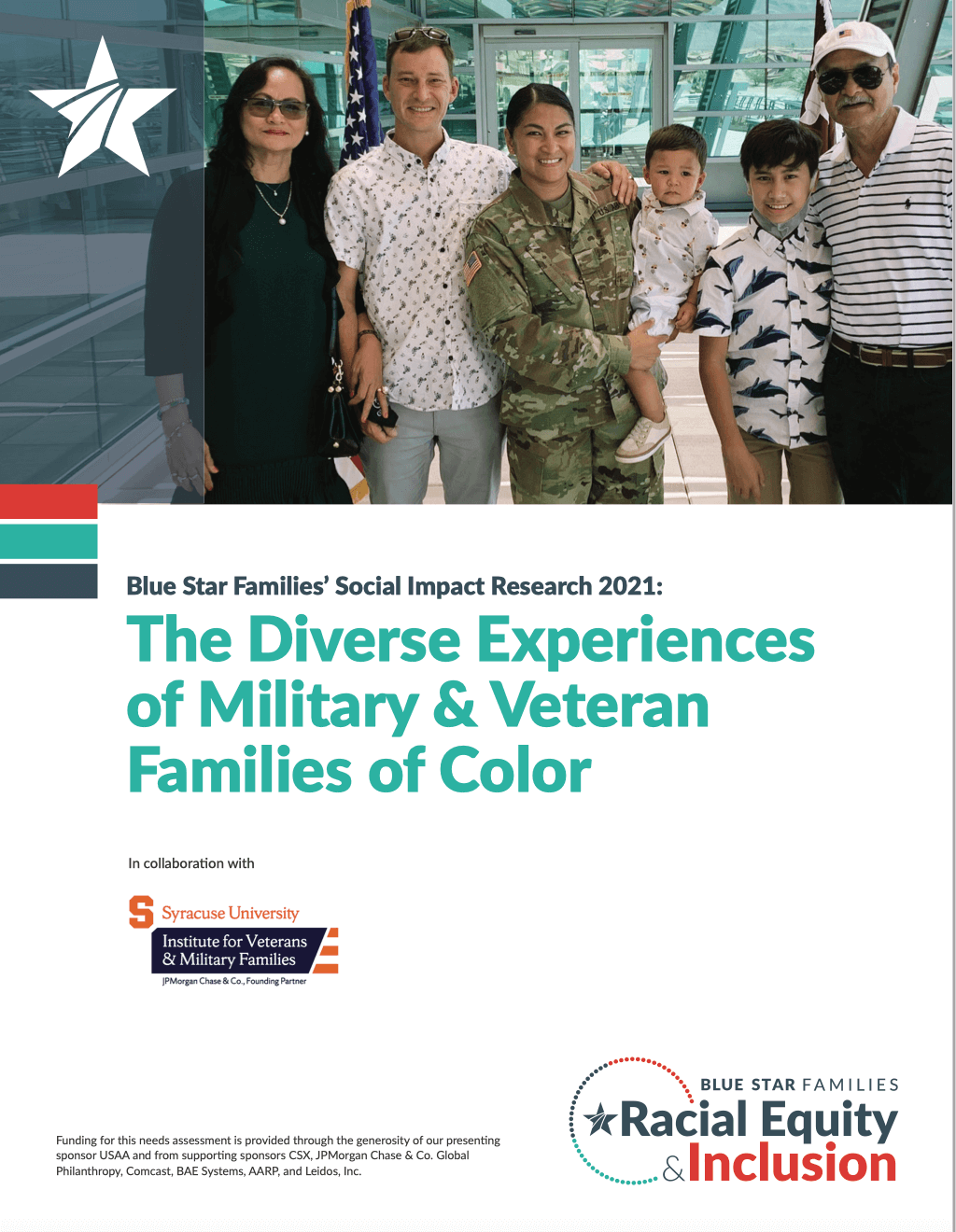
2021 Comprehensive Report
Special Report: Discrimination in the Military
Service members report experiencing racial and gender discrimination, potentially impacting readiness and retention.
Most did not report the most recent incident of discrimination. Also, a smaller proportion of those active-duty service member respondents who experienced military-connected racial discrimination (43%) would recommend service than those who had not experienced discrimination (63%). Nearly one in 10 respondents who are Veterans of color (8%) report racial discrimination as one of the reasons they left military service. (2020 Military Family Lifestyle Survey)
Methodology & Sample
This 14 month research effort included an extensive search of the relevant literature and original analysis of public data sources, focus groups, a survey, and culminated in this report of results and recommendations. The study utilized a mixed-methods approach and convenience sampling methods to ensure a robust representation of military and Veteran family respondents of color. The total sample (2,731 respondents) includes service members, Veterans, and spouses of color, as well as white, non-Hispanic respondents who are part of multiracial/multiethnic families.
Media & Partnership Inquiries
If you are a member of the media or a nonprofit organization that supports military- and Veteran-connected communities and you are interested in partnering with Blue Star Families to promote Blue Star Families’ Social Impact Research 2021: The Diverse Experiences of Military & Veteran Families of Color, contact [email protected].
Funders
Funding for this needs assessment is provided through the generosity of our sponsors. If you are interested in funding further research, use the button below.
Quick Links
Authors
From the Department of Applied Research at Blue Star Families, in collaboration with Syracuse University’s Institute for Veterans and Military Families (IVMF).
BLUE STAR FAMILIES
Jennifer L. Akin, M.P.A., Co-Director of Applied Research
Cynthia C. Rivera, M.S.W, Senior Manager of Equity and Social Impact Research
Carrie E. Carter, M.Ed., Applied Research Generalist Consultant
Jessica D. Strong, Ph.D., Co-Director of Applied Research
Ingrid Herrera-Yee, Ph.D., Senior Applied Research Analyst Consultant
Charo K. Bates, M.B.A., M.A., M.S., Policy & Social Impact DEPLOY Fellow
Kelley M. Klor, Food Insecurity DEPLOY Fellow
Ashley B. Scott, Policy & Outreach Fellow
Jerel Ezell, Ph.D., M.P.H., Senior Applied Research Analyst Consultant for Focus Groups
D'ANIELLO INSTITUTE FOR VETERANS AND MILITARY FAMILIES
Rosalinda V. Maury, M.S., Director of Applied Research and Analytics
Mariah Brennan Nanni, M.P.A., Doctoral Research Fellow
Rachel K. Linsner, M.S., Research Associate
Jeanette Yih Harvie, Ph.D., Research Associate
Presenting Sponsor

Supporting Sponsors









In Collaboration With: